

Funny thing about numbers, they don’t really stay numbers in your head for long. They become bananas in the fruit basket, or that slightly awkward phone screen you squint at at night, or even the way your hand just kinda “knows” a size without asking permission.
And 7 inches specifically… it has this strange habit of appearing in places you’d never expect, like it’s quietly traveling through everyday life, hiding in plain sight.
If someone says “7 inches = ~17.78 cm”, your brain nods politely but forgets it in two seconds. But if someone says “about the size of a Banana (medium size) or a Standard pencil,” suddenly it clicks. That’s the magic of visual reference measurement, where abstract numbers turn into things your eyes and hands already understand.
In real life, 7 inches = ~0.58 feet, but nobody really walks around thinking in feet mid-conversation unless they’re building a shelf or arguing with a tape measure.
Instead, we rely on informal measurement systems, little mental shortcuts built from everyday objects like Credit cards, Toothbrush, and even a slightly bent Ruler (compact 7-inch variant) that’s been in your drawer since forever.
And honestly, there’s something kinda comforting about that.
| Item | Approx. 7-inch Reference |
|---|---|
| Standard pencil | Close to 7 inches in full length |
| Toothbrush | Typical adult size range |
| Butter knife | Common kitchen utensil length |
| Kitchen knife | Small prep knife (~7 in context) |
| Scissors | Compact household size |
| Banana (medium) | Natural visual reference |
| Credit cards (stacked) | ~3 stacked cards ≈ 7 inches |
| Paper clips (lined up) | Several aligned in a row |
| US quarters (row) | Multiple coins aligned |
| Ruler (compact 7-inch variant) | Direct measuring tool |
| Golf balls (comparison line) | Used for visual estimation |
| Salad plate (small) | Diameter close in some cases |
| Hand span (some adults) | Thumb to finger stretch |
| Smartphone width (older/compact models) | Visual comparison reference |
Understanding 7 Inches (in) in real life
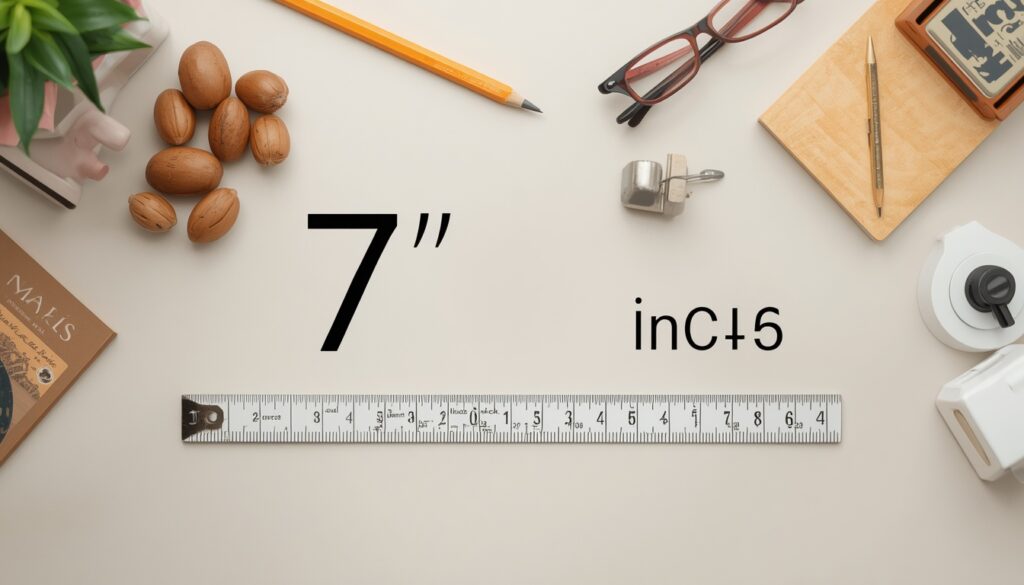
Let’s talk straight. Inch (in) as a unit is tiny but powerful. It sneaks into everything phones, kitchen tools, sports gear and yet we rarely respect how often we use it mentally.
When we say 7 inches in cm, we’re talking about 17.78 cm, but that number alone doesn’t stick emotionally. What sticks better is stacking real things. That’s where stacking method (coins, cards, paper clips) becomes a weirdly satisfying trick.
You could line up US quarters (coins) in a row, or stack a few Paper clips, and boom you’ve got yourself a rough ruler without ever touching a measuring tape. That’s part of DIY measurement hacks, and honestly, people use it more than they admit.
Then there’s body-based measurement (hand span, palm span, thumb width). Some adults find their Palm-to-middle-finger length (~7 inches in some adults) surprisingly close to 7 inches. It’s not exact science, more like “close enough for comfort,” which is very human, if you think about it.
Even Spatial cognition (understanding size visually) plays tricks here. Your brain starts mapping 7 inches as “small but not tiny,” like something you can hold, swipe, or lightly toss without worry.
Tech & Gadgets: The 7-inch object ecosystem
Now this is where things get interesting. Tech products love this size range because it sits right in that sweet ergonomic zone—portable, but still readable. That’s part of Ergonomic design (tool size comfort), where 7-ish inches feels just right in hand usage.
Here are some common tech-related items or comparisons in the “7-inch Object Ecosystem”:
- Apple iPad 10th Generation (not exactly 7 inches, but often compared in screen scaling discussions and visual sizing guides)
- iPhone 16 Pro Max (again larger, but used as a mental anchor in smartphone size comparison debates)
- Samsung Galaxy S25 Ultra (big phone category, but helps users understand scale differences)
- Portable media devices used in visual representation of 7 inches
- Compact tablets or older mini-tablets close to 7-inch class
- E-reader devices in similar ergonomic width range
- Handheld gaming consoles (some fall near this dimension range in grip width)
- Smart remotes and controller grips designed around portable device dimensions
Even though modern devices vary, people still mentally map them using everyday size reference like a Credit cards stack or a Standard pencil laid next to the screen.
And yeah, sometimes someone will casually say “this feels like around 7 inches” while holding a phone, even if it’s not scientifically correct. That’s Approximate measurement doing its social job.
Office, Writing Tools & Everyday Stationery around 7 inches
Office supplies are secretly the most reliable 7 inch objects list you’ll ever find. They don’t lie, they don’t stretch, they just exist.
Here are some solid examples of things that are 7 inches long in this category:
- Standard pencil
- Medium Scissors
- Aligned stack of Paper clips
- A neat row of Credit cards
- Short office rulers like Ruler (compact 7-inch variant)
- Binder clips lined edge to edge
- Sticky note stacks (thicker bundles)
- Small notepads used in desks
- Stylus pens for tablets like Apple iPad 10th Generation accessories
- Slim markers used in design work
There’s something oddly satisfying about aligning Paper clips in a straight line just to “feel” 7 inches visually. That’s part of Cognitive anchoring via familiar objects, where your brain says “oh yeah, I know this size.”
Also, how big is 7 inches visually becomes way easier when you realize a Standard pencil is often close enough to act like a natural ruler. People don’t talk about it much, but offices are basically silent measurement labs.
Kitchen, Household & Ergonomic Size Optimization

Now we enter the kitchen zone, where Ergonomic size optimization really shines. Tools here are built for grip, balance, and comfort—not just aesthetics.
Common common 7 inch items in this space include:
- Butter knife
- Small Kitchen knife (approx. 7 inches in context)
- Compact spatulas
- Ladles with shorter handles
- Mini chopping tools
- Salad plate (small) diameter comparisons
- Serving tongs in snack sets
- Tea spoons arranged in sets
- Measuring spoons bundled together
- Small cutting boards
A Kitchen knife (approx. 7 inches in context) is especially interesting because chefs often say this is the “control sweet spot.” Not too long, not too short just balanced enough for precision cuts without feeling like a sword fight.
And then there’s the humble Salad plate (small), which doesn’t measure 7 inches directly in length but often helps people visually compare diameter-based sizing. That’s Cross-Domain Size Consistency in action different shapes, same mental scale.
DIY Measurement Hacks & Human Body Ruler System
This section is where things get a bit wild but also strangely practical.
Humans have always measured things with their bodies before rulers existed. That’s the core of Human-Centered Measurement System.
Here’s how people approximate 7 inches without tools:
- Hand span measurement
- Thumb width measurement
- Palm-to-finger distance
- Using Body-based measurement (hand span, palm span, thumb width)
- Comparing with Banana (medium size)
- Aligning Credit cards in a row
- Using US quarters (coins) stacking method
- Lining up Paper clips
- Comparing with a Toothbrush
- Using a folded napkin as rough scale guide
A medium Banana (medium size) is one of the most iconic mental rulers in the world. People don’t realize it, but this fruit has been doing global measurement work for decades.
And yes, DIY measuring hacks aren’t perfect, but they’re surprisingly reliable for rough tasks. Nobody’s building a bridge with bananas (hopefully), but for quick estimation? It works.
Nature, Sports & the Strange Familiarity of 7 Inches
Now here’s where cognition gets playful.
In sports and casual objects, 7 inches shows up in odd ways:
- Golf balls aligned in rows (stacking reference)
- Short segments of sports grips
- Half-reference of a Bowling pin (half reference) when visually cut in imagination
- Compact training gear handles
- Small sports bands or grips
- Golf balls
- Bowling pin (half reference) comparisons
- Grip sections on sports equipment
These aren’t always exactly 7 inches, but they live in the same mental neighborhood. That’s Everyday object scaling, where your brain doesn’t demand precision, just similarity.
And that’s how what does 7 inches look like becomes easier to answer: it looks like something you’ve already held without thinking too hard about it.
Why 7 inches feels so familiar (and a bit everywhere)
There’s a reason this number keeps showing up across tech, kitchen tools, stationery, and even food items. It’s not random—it’s ergonomic psychology.
The idea of Ergonomic design (tool size comfort) explains a lot. Tools that fit comfortably in human hands often cluster around similar dimensions. Not identical, but close enough that your brain groups them together.
This creates a strange illusion of consistency across domains phones, knives, pencils, plates all quietly echoing each other in size language. That’s Cross-Domain Size Consistency again doing its invisible job.
And honestly, once you start noticing it, you can’t unsee it.
14 Common Things That Are Around 7 Inches Long
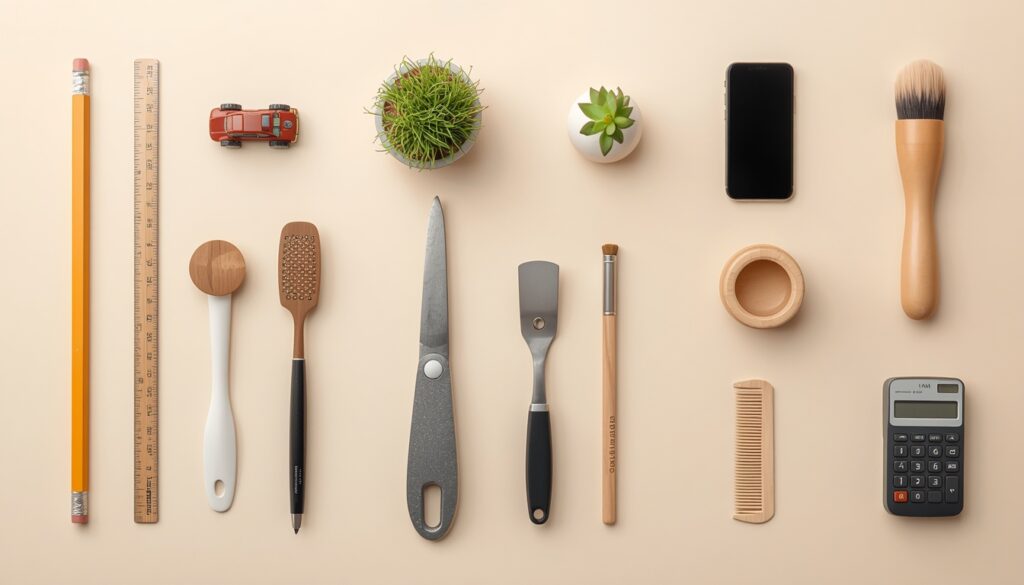
Here’s a clean mental snapshot of things that are 7 inches long or very close:
- Standard pencil
- Toothbrush
- Butter knife
- Kitchen knife (approx. 7 inches in context)
- Scissors
- Banana (medium size)
- Credit cards stacked length
- Paper clips lined up
- US quarters (coins) row
- Salad plate (small) diameter reference
- Ruler (compact 7-inch variant)
- Golf balls arranged in measurement comparison
- Bowling pin (half reference visual scaling)
- Hand span (some adults)
Each of these contributes to everyday objects 7 inches understanding, not through math, but through repetition in daily life.
Frequently Asked Questions
7 inches comparison
7 inches is about the length of a standard pencil or slightly longer than a toothbrush, making it a medium small everyday size.
is 7.5 inches long
Yes, 7.5 inches is slightly longer than 7 inches and is commonly seen in items like pencils or small kitchen knives.
how big is 7 inches compared to an object
7 inches is roughly the size of a medium banana or the width of a small tablet, fitting comfortably in an adult hand.
7 inches example
Examples of 7 inches include a butter knife, toothbrush, small garden trowel, and some salad plates in diameter.
objects that are 7.5 inches
Objects around 7.5 inches include longer pencils, half a bowling pin, and certain household knives that are slightly above average size.
Read this Blog: https://zyroxin.com/8-inches/
Conclusion: When measurement becomes memory
At the end of it all, 7 inches is not just a number it’s a shared illusion built from objects we trust. A Toothbrush, a Standard pencil, a Banana (medium size), or even a stack of Credit cards all quietly teach us what that length feels like without ever mentioning a ruler.
That’s the beauty of unit conversion (inches ↔ cm ↔ feet) when it leaves the textbook and enters real life it becomes tactile, imperfect, human.
So next time someone asks “what is 7 inches long?”, you won’t just think of 7 inches in cm or 0.58 feet in inches. You’ll think of a dozen everyday things quietly lining up in your memory, all whispering the same size in slightly different ways.
And maybe that’s the real trick our brains don’t measure life in numbers alone, they measure it in bananas, pencils, and little familiar objects we keep bumping into every day, almost without noticing.