

You spotted STSU in a text message, paused for a second, and probably wondered whether it was a joke, an insult, or some new Gen Z slang you’ve never seen before. You’re not alone. Internet language changes fast, and abbreviations seem to appear overnight.
The good news? STSU isn’t nearly as complicated as it looks.
In this guide, you’ll learn the exact STSU meaning in text, where people use it, how it sounds in different conversations, and what you should say when someone sends it to you.
Quick Answer: What Does STSU Mean?
The most common answer to what does STSU mean in text is:
“Shut The Stuff Up” or a softened variation of a stronger phrase often used jokingly among friends.
In most online conversations, STSU is used as a reaction when someone says something surprising, funny, embarrassing, or hard to believe.
For example:
Friend: “I accidentally sent my crush a screenshot of our chat.”
Friend 2: “STSU no way!”
In this situation, STSU isn’t meant as an insult. It’s simply expressing shock or disbelief.
What Does STSU Stand For in Text Messages?
Like many internet acronyms, STSU can have slightly different interpretations depending on the conversation.
Most Common Meaning of STSU
The most widely recognized STSU meaning slang users understand is a playful version of telling someone to stop talking because what they just said is unbelievable.
Think of it as:
- “No way.”
- “You’re kidding.”
- “Stop, that’s crazy.”
- “I can’t believe that.”
Many users prefer STSU because it feels less aggressive than stronger internet slang terms.
Alternative Meanings of STSU
Context matters.
In some online communities, users may interpret STSU differently. Alternative meanings can include:
- A sarcastic reaction
- A playful dismissal
- A humorous response to gossip
- An expression of disbelief
Because internet language evolves constantly, meanings sometimes shift between platforms and friend groups.
Why STSU Has Different Interpretations
Unlike traditional dictionary words, internet acronyms develop organically.
A phrase may start in one online community and spread to others through:
- TikTok comments
- Snapchat stories
- Instagram DMs
- Group chats
- Gaming communities
As a result, people occasionally use the same abbreviation in slightly different ways.
How STSU Is Used in Everyday Conversations
Understanding the tone behind STSU is often more important than understanding the letters themselves.
Friendly Conversations
Among friends, STSU usually feels playful.
Example:
Alex: “I won concert tickets for free.”
Sam: “STSU! That’s amazing.”
Here, the reaction shows excitement rather than annoyance.
Funny Responses
Many people use STSU when reacting to something ridiculous.
Example:
Friend: “My dog stole my sandwich and hid it under the couch.”
Reply: “STSU that’s hilarious.”
The phrase acts as a reaction rather than a command.
Sarcastic Usage
Sometimes STSU appears with a sarcastic tone.
Example:
Friend: “I’m definitely becoming a millionaire this month.”
Reply: “STSU.”
The response signals doubt while keeping the conversation light.
Angry or Rude Contexts
Tone can change everything.
If someone writes STSU during an argument, it may come across as dismissive or disrespectful.
That’s why understanding the relationship between the people chatting is essential.
STSU Meaning on Different Social Media Platforms
Different platforms create different communication styles.
STSU Meaning on Snapchat
When people search for STSU meaning on Snapchat, they’re usually seeing it in private chats or story replies.
On Snapchat, STSU often appears as:
- A shocked reaction
- A playful response
- A reply to embarrassing stories
- A reaction to gossip
Snapchat users frequently rely on quick chat abbreviations, making STSU fit naturally into the platform.
STSU Meaning on TikTok
TikTok thrives on reactions.
You’ll often see STSU in:
- Comment sections
- Viral videos
- Storytime content
- Funny clips
Someone might comment:
“STSU this can’t be real.”
The phrase communicates disbelief and surprise in a short format.
STSU Meaning on Instagram
If you’re wondering what does STSU mean on Instagram, the answer is usually similar.
Instagram users often use STSU in:
- Direct messages
- Reels comments
- Story replies
- Group conversations
It’s commonly paired with laughing emojis or reaction emojis.
STSU Meaning on WhatsApp
WhatsApp conversations tend to be more personal.
In group chats, STSU is often used when reacting to:
- Family stories
- Friend gossip
- Funny photos
- Unexpected news
The tone is usually casual and friendly.
STSU Meaning in SMS Texts
Traditional text messaging still uses plenty of internet slang.
STSU works the same way in SMS texting as it does on social media platforms.
The key factor remains context.
Examples of STSU in Text Conversations
Real examples make slang easier to understand.
Example 1: Friends Chatting
Friend 1: “I forgot my own birthday password.”
Friend 2: “STSU that’s impossible.”
Example 2: Flirty Conversation
Person A: “I may have been stalking your profile.”
Person B: “STSU lol.”
Here, the response feels playful and flirtatious.
Example 3: Funny Reaction
Friend: “I waved back at someone who wasn’t waving at me.”
Reply: “STSU I’m crying.”
The phrase amplifies the humor.
Example 4: Serious Argument
Person A: “You never listen.”
Person B: “STSU.”
In this context, the phrase could sound rude or dismissive.
How to Respond When Someone Says STSU
Not sure how to reply?
Your response should match the mood of the conversation.
Friendly Responses
Try:
- “I’m serious.”
- “It’s true.”
- “Believe it.”
- “I swear.”
Funny Responses
You could say:
- “I wish I was joking.”
- “This gets worse.”
- “Wait until you hear the next part.”
- “You haven’t heard everything yet.”
Serious Responses
If the conversation feels tense, consider:
- “Let’s talk calmly.”
- “That’s not what I meant.”
- “Can we discuss this properly?”
Reading the tone before responding can prevent misunderstandings.
Is STSU Considered Rude?
This is one of the most common questions people ask.
The answer depends on context.
When It Is Harmless
STSU is generally harmless when:
- Used among friends
- Accompanied by humor
- Used as a playful response
- Shared in casual conversation
When It Can Be Offensive
Problems arise when STSU is:
- Directed aggressively
- Used during arguments
- Sent to someone unfamiliar with the slang
- Intended to dismiss another person’s feelings
Understanding Tone and Context
Internet language rarely exists in a vacuum.
The same message can sound:
- Funny
- Sarcastic
- Friendly
- Rude
Everything depends on who is speaking and why.
Similar Slang Terms Related to STSU
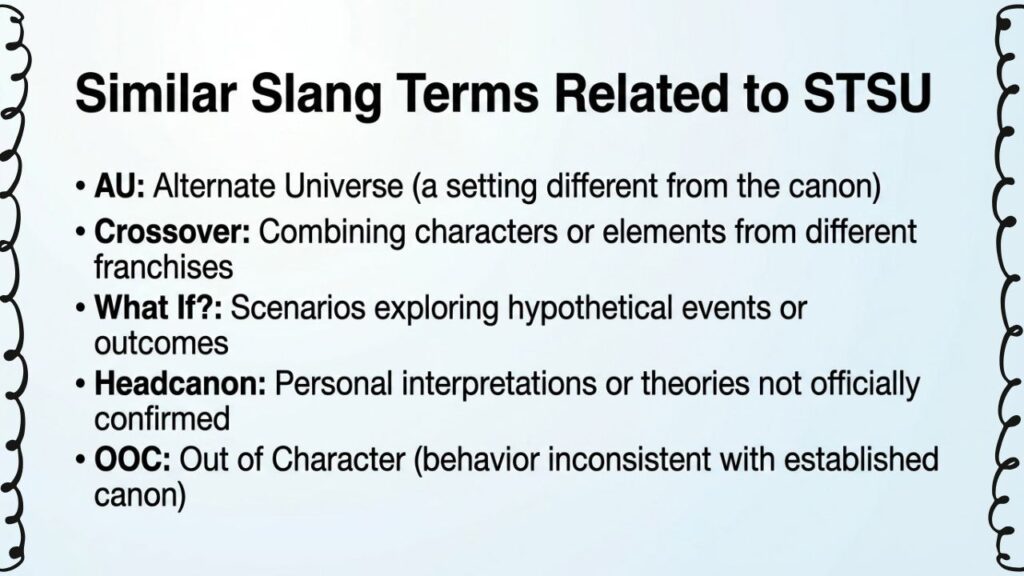
Understanding related slang helps you become more fluent in modern texting culture.
STFU
A much stronger and more direct phrase that is often considered offensive.
TBH
Short for “To Be Honest.”
Used when expressing a genuine opinion.
IMO
Means “In My Opinion.”
Common in discussions and debates.
NGL
Short for “Not Gonna Lie.”
Often introduces a truthful statement.
WYA
Means “Where You At?”
Common in text messaging and social media slang.
Why Internet Slang Like STSU Is So Popular
Texting culture rewards speed.
People want to communicate quickly without typing long messages.
Faster Communication
A four-letter acronym can replace an entire sentence.
That’s efficient.
Social Media Culture
Platforms encourage short-form communication.
Users naturally create abbreviations to save time.
Gen Z Influence
Gen Z has played a huge role in shaping modern slang.
New expressions spread rapidly through:
- TikTok trends
- Instagram Reels
- Snapchat stories
- Online communities
- Gaming chats
Many viral phrases become part of everyday digital communication within weeks.
tsmeaning.com/what-does-stsu-mean-in-text/
Frequently Asked Questions About STSU
What does STSU mean in text?
STSU is commonly used as a playful reaction expressing disbelief, surprise, or amusement in a text message.
Is STSU rude or offensive?
Not usually. Among friends, it is often harmless. In heated conversations, it may sound rude.
What does STSU mean on Snapchat?
On Snapchat, STSU is typically used as a joking reaction to surprising or embarrassing stories.
What does STSU mean on TikTok?
TikTok users often use STSU in comments when reacting to funny, shocking, or unbelievable content.
How do you respond to STSU?
You can respond with humor, clarification, or additional details depending on the conversation.
Is STSU popular among Gen Z?
Yes. Gen Z regularly adopts texting abbreviations and internet slang to communicate faster online.
stsu meaning in text
STSU is a texting slang abbreviation commonly used to express surprise, disbelief, or a playful reaction during an online conversation. The exact meaning can vary depending on the context and the relationship between the people chatting.
what does stsu mean in text
In text messages, STSU is often used as a reaction phrase when someone shares shocking, funny, or unexpected news. It usually conveys a sense of “no way” or “I can’t believe that.”
what does stsu mean
STSU generally refers to a casual internet acronym used in texting and social media conversations. Its interpretation depends on the tone of the discussion and the platform where it is used.
stsu meaning
The meaning of STSU is typically linked to online messaging, where users employ it as a quick and expressive response. It is most commonly seen in casual chats among friends.
stsu
STSU is a modern chat abbreviation that appears on platforms like Snapchat, TikTok, Instagram, and text messages. People often use it to react to surprising, amusing, or unbelievable situations.
Final Thoughts on STSU Meaning in Text
If you came here searching for what does STSU mean in text, the short answer is that it’s usually a playful reaction expressing surprise, disbelief, or amusement.
Still, context matters.
A message between close friends may sound completely different from the same message during an argument. That’s true for nearly every piece of modern slang. As internet culture continues to evolve, abbreviations like STSU will keep appearing across Snapchat, TikTok, Instagram, WhatsApp, and text messages.
The next time someone sends STSU, you’ll know exactly what they’re trying to say—and, just as importantly, how they’re probably feeling when they say it.