

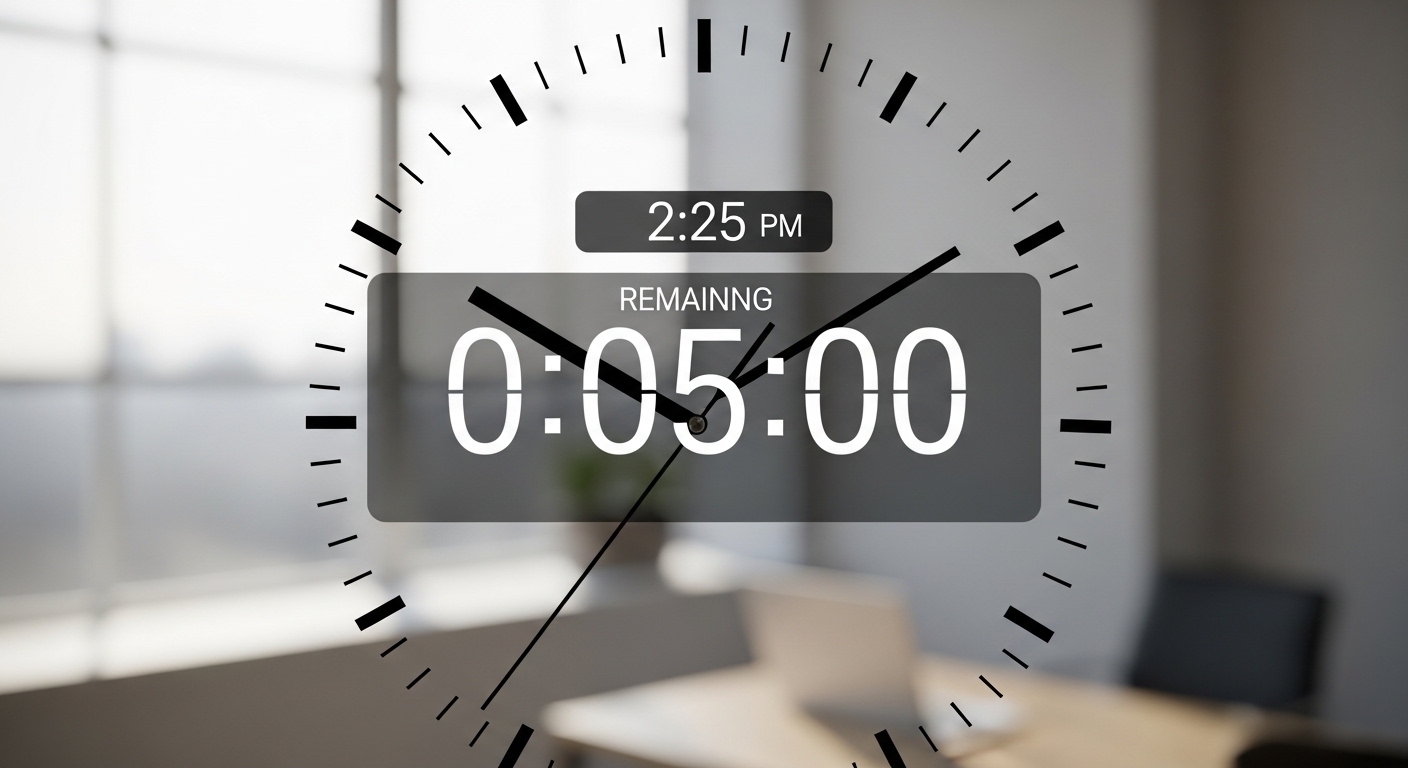
There are afternoons that don’t just pass… they kind of linger, like they forgot their shoes at the door and now they’re waiting awkwardly in the hallway of your mind. And somewhere inside that strange soft delay, the question shows up again and again: how long until 2:30 PM?
Maybe it’s a meeting. Maybe it’s a call that matters more than it should. Or maybe it’s just that tiny pocket of the day where everything feels paused, suspended in a warm, slightly jittery silence. You glance at the current time, then again a second later, even though you already know it didn’t change much. Still, you check. Humans do that.
And so begins the little emotional experiment of Time perception, where every minute becomes heavier than it has any right to be. Seconds stretch, minutes, behave strangely, and hours feel like they’re pretending not to move. It’s not just waiting it’s a full Waiting experience with its own soundtrack of thoughts, distractions, and sudden bursts of “is it 2:30 yet?”
Somewhere in the background of all this sits the invisible machinery of Time measurement, quietly doing its job while we emotionally misinterpret it like artists who refuse to read the instructions.
| Item | Value |
|---|---|
| Target Time | 2:30 PM |
| Current Time | (your device time) |
| Time Remaining | ⏳ Depends on current time |
The Emotional Pulse of How Long Until 2:30 PM
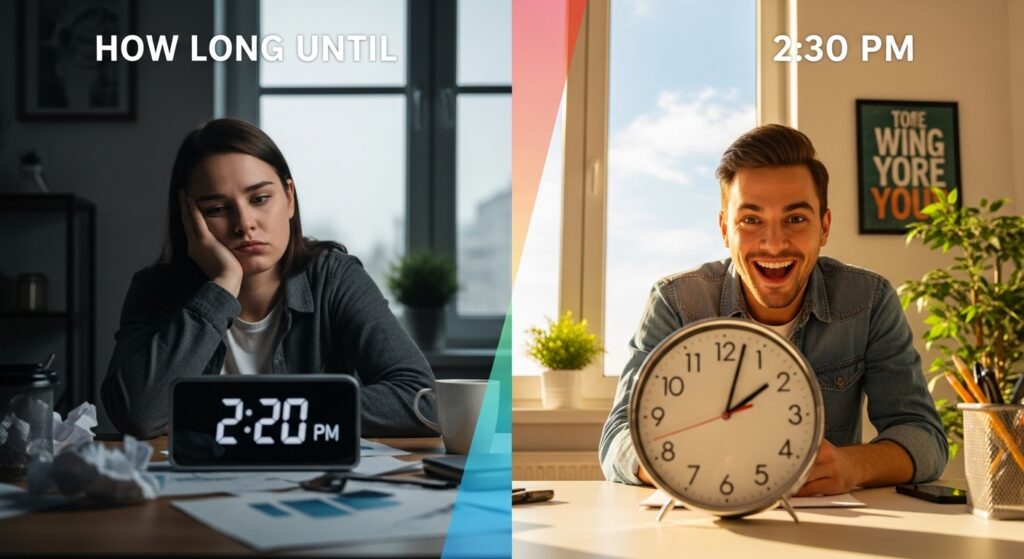
When you ask how long until 2:30 PM, you’re not just checking numbers you’re stepping into a tiny ritual of anticipation. The brain doesn’t treat it as a neutral calculation. Instead, it becomes a soft mental echo, repeating itself like a song stuck on low volume.
In these moments, Anticipation builds like pressure in a sealed jar. You feel it in small ways: tapping fingers, glancing at clocks, switching tabs, pretending to focus. It’s all part of the Emotional weight of time, where even a few seconds can feel oddly meaningful.
People often underestimate how deeply Human perception of time flow bends in such situations. A boring stretch before 2:30 PM (target time) feels longer than the entire morning. Yet when you’re distracted, suddenly it jumps like time got shy and skipped ahead.
Some folks even describe it as a mild form of Time anxiety and anticipation, though it’s not always negative. Sometimes it’s exciting. Sometimes it’s just… oddly alive.
And yes, you might notice yourself mentally counting: “okay, still a bit left… maybe 2:35 PM… then 2:40 PM… alright, getting closer…”
Even if nothing changes on the outside, everything shifts inside.
How Long Until 2:30 PM Countdown Experience
The phrase how long until 2:30 PM countdown experience sounds technical, but in real life it’s messy, human, and a bit chaotic in a charming way.
You might open a Countdown Timer tool like Countdown Timer just to make sense of it all. Or maybe a Time Until Calculator, or even a Duration calculator if you’re feeling slightly more analytical than usual.
Some people go full digital mode with Timer tools / services, switching between tabs like they’re managing a spaceship console. Others prefer a simple fullscreen timer mode, because watching numbers grow or shrink feels strangely grounding.
And then there’s the classic behavior: checking again anyway.
We interact with these systems through Time input field, maybe a Date input field, sometimes even a Name input field (optional personalization) when we’re feeling fancy. If it’s a reminder setup, we might add an Email input field (reminders) so future-us gets notified like a responsible adult version of ourselves.
A lot of platforms now include Notification / reminder system, Update timer feature, and even Feedback / suggestion system, which we almost never use but appreciate in theory.
And yes, even a tiny Comment box / comment field can become a place where someone writes “pls hurry 2:30 thx” like it’s a sacred prayer.
This is where Ritualization of time sneaks in quietly. We don’t just wait anymore we structure waiting.
Tools, Systems, and Digital Time Machines
Modern waiting is digital. It’s layered with apps, widgets, and interfaces designed to make time feel more controllable, even when it absolutely isn’t.
You’ve got online countdown timer tools, time tracking apps, and productivity timer tools that promise clarity. There’s even digital stopwatch and timer apps that turn seconds into something you can visually argue with.
Some systems go deeper, offering customizable timer interface options colors, fonts, tiny animations that try to make waiting feel less like waiting. That’s where Theme customization (colors, logos) comes in, because yes, even anticipation wants aesthetics now.
And if you’re multitasking, Multi-timer tracking becomes a thing because apparently we don’t just wait for one moment anymore, we juggle several.
In professional or structured environments, Scheduling tools and Reminder system software quietly manage the flow of expectations. They shape Temporal awareness without us even noticing.
There’s also something oddly comforting about seeing Related countdown views, like other people are also waiting for something, somewhere, at roughly the same time.
We’re all just different tabs open in the same browser of time.
Psychology Behind the Waiting Experience
Let’s get slightly weird (but real) for a moment.
The psychology behind waiting for 2:30 PM is tied to Cognitive perception of waiting. The brain doesn’t measure time like a clock—it measures it like emotion.
When we are engaged, time shrinks. When we are waiting, it expands. This is why the Perception of time passing changes so dramatically depending on mood.
This is also where Mindfulness and time awareness enters the scene. Some people try to observe the wait rather than fight it. Others try to distract themselves completely.
A fascinating part of this is Psychological effect of delayed gratification. Even small delays like waiting for 2:45 PM after 2:40 PM can feel like emotional checkpoints.
We also experience Temporal motivation systems, where urgency suddenly increases productivity. Tasks get done faster because the brain says: “if I finish this, maybe time moves faster too.”
It doesn’t. But we believe it might.
That belief itself becomes a kind of Gamification of time, where waiting becomes a score-based system: survive until 2:30, then unlock relief.
Countdown Checkpoints and Micro-Moments of 2:30 PM
The journey to 2:30 PM target time rarely feels linear. It breaks into fragments tiny emotional milestones.
You pass 2:35 PM, then correct yourself mentally (“wait, that’s after… ignore that”). You drift through 2:40 PM, then suddenly imagine 2:45 PM as if it’s a distant destination. Then 2:50 PM feels like “okay that’s definitely too far, let’s not go there emotionally.”
These are Countdown checkpoints, little mental bookmarks in the river of waiting.
This is also where Micro-event structuring of time appears. We start dividing minutes into events: check phone, stretch, sip water, re-check clock, pretend not to check clock.
Some people even adopt Task-based countdown behavior, assigning meaning to each segment of time until the event arrives.
And during all this, Live countdown tracker tools quietly update in the background, offering real-time timer updates like a calm narrator of your impatience.
Personalizing Your Countdown Experience
Modern tools love personalization. And honestly, so do we.
A Personalized countdown timer can turn a bland wait into something strangely intimate. You might set a name, adjust the theme, or receive notification alerts for time that feel like gentle nudges from the universe.
Some systems even allow User personalization, shaping the entire interactive countdown experience based on preferences.
Behind the scenes, developers think about Time tracking tools, time interval measurement, and time conversion tools, but users just think: “please tell me when it’s 2:30 already.”
There’s also a subtle emotional shift when using these tools. The wait feels less abstract. More structured. Almost respected.
And that’s where Temporal engagement systems come alive bridging human impatience with machine precision.
Creative Ways People Experience the Wait
Not everyone waits the same way. Some people journal during it, others scroll endlessly, and some just stare into space like it owes them money.
There’s Journaling during countdown, where people write thoughts that don’t always make sense later. There’s Social sharing (Facebook, Twitter) where people casually announce “waiting for 2:30 like it’s a life event.”
Then there’s Reminder notifications, popping up like polite interruptions from future-you.
Some even turn it into a habit-building system using Productivity timing rituals, where each countdown becomes a mini discipline exercise.
And in oddly structured lives, Flow of daily micro-events becomes the real rhythm of the day.
One user once described it like this:
“My grandpa used to say, time don’t rush you… you rush yourself inside it. He wasn’t fancy, but he was right in a strange way.”
It’s not scientific, but it feels emotionally accurate.
A Quiet Reflection on Waiting for 2:30 PM
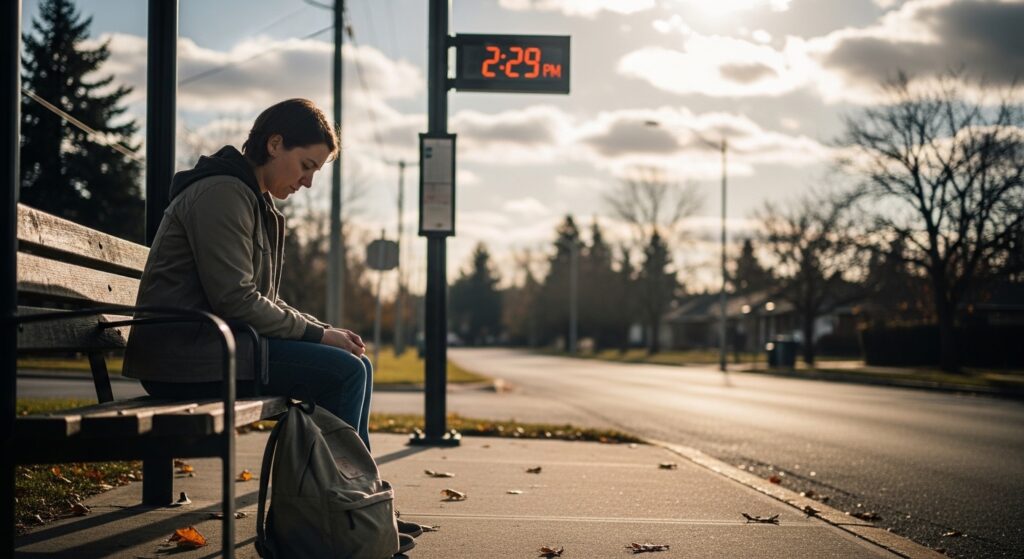
At its core, waiting for 2:30 PM (target time) is not really about time itself. It’s about attention. It’s about how we hold ourselves inside a moment that hasn’t finished arriving yet.
We build systems, use apps, set reminders, and rely on Time Until Calculator tools just to soften the edges of uncertainty. But the real experience lives in the gaps between updates.
Even hours and minutes until event calculations can’t fully capture that human layer of hesitation, hope, or boredom.
And somehow, that’s okay.
Because waiting is also a kind of quiet storytelling.
Frequently Asked questions
how long till 2 30
The time until 2:30 depends on the current local time. You simply calculate the difference between now and 2:30 PM today to know the remaining hours, minutes, and seconds.
how many more minutes until 2 30 pm today
To find the minutes remaining until 2:30 PM today, subtract the current time from 2:30 PM and convert the result into total minutes.
how long until 2 30 pm
The duration until 2:30 PM is the time left from the current moment, measured in hours, minutes, and seconds until that exact target time.
how many more minutes until 2:30 pm today
The remaining minutes until 2:30 PM today are calculated by comparing the current time with 2:30 PM and converting the difference into minutes.
how long till 2:30
It is the time gap between now and 2:30, which can be expressed in hours, minutes, and seconds depending on the current time.
Read this Blog: https://zyroxin.com/how-long-until-230-pm/
Conclusion: When 2:30 Finally Arrives
When 2:30 PM finally happens, it rarely feels dramatic. There’s no trumpet sound, no cinematic pause. Just a small internal shift—like a page turning without ceremony.
All the duration calculator checks, the live countdown tracker refreshes, the glances at current time, the mental math of seconds remaining countdown… it all dissolves into “oh, it’s here.”
And then life moves on to the next micro-wait, the next small anticipation, the next unnoticed countdown we’ll pretend doesn’t matter until it suddenly does.
So if you ever find yourself asking again how long until 2:30 PM today, remember: the answer is not just numbers. It’s experience. It’s attention. It’s that odd, very human space between now and almost-now.
And maybe, just maybe, that space is where most of life quietly happens.